

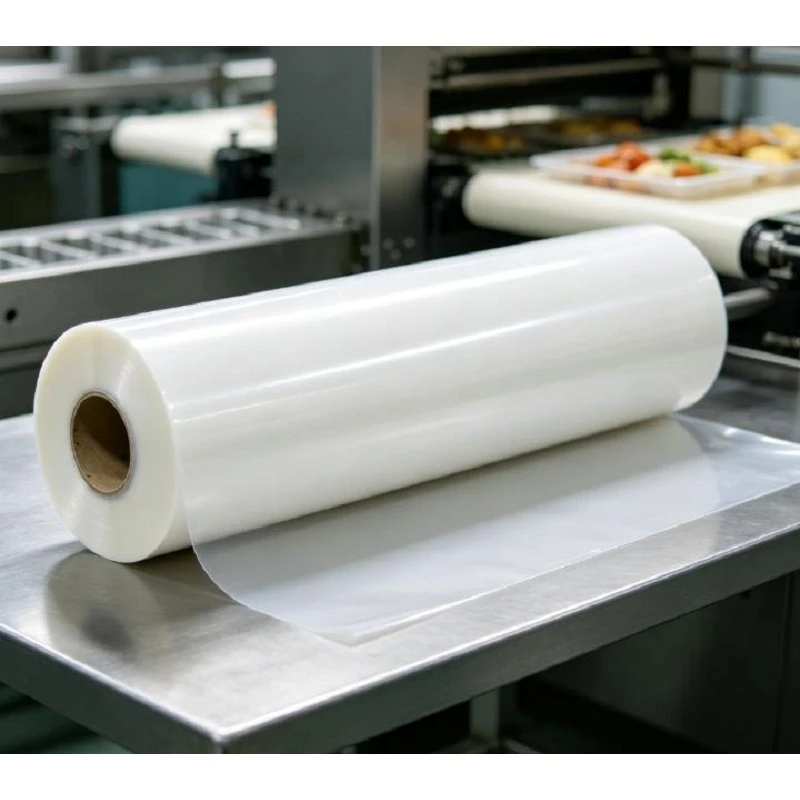
White Thermoforming Packaging Film is a multilayer film for thermoformed food packaging requiring a white, opaque appearance. The structure combines thermoformable polymer layers, a white functional layer, and a heat-sealing layer. Surlyn-based sealing structures are available for compatible package constructions.
Film thickness, width, layer structure, forming depth, sealing interface, and roll configuration are specified according to the package design and processing condi
Key Advantages
White Opaque Surface
The white functional layer provides an opaque package surface with controlled visual coverage after thermoforming.
Balanced Film Structure
The multilayer construction combines forming, appearance, and sealing functions within one film structure for thermoformed food packs.
Sealing Layer Selection
The sealing layer can be specified according to the bottom-web material, seal interface, and operating conditions used in production.
Configurable Construction
Film structure can be selected around thickness, forming depth, barrier requirements, package geometry, and sealing requirements.
Technical Specifications
|
Parameter |
Specification |
|
Film Type |
Multilayer thermoforming packaging film |
|
Appearance |
White / opaque |
|
Standard Thickness |
80 / 100 / 125 / 150 μm |
|
Width |
Customized |
|
Layer Structure |
Multilayer coextruded structure |
|
Sealing Layer |
PE-based or Surlyn-based |
|
Barrier Layer |
Available by specification |
|
Forming Process |
Thermoforming |
|
Sealing Process |
Heat sealing |
|
Roll Configuration |
Customized |
Material & Layer Structure
Forming Layers
Thermoformable layers provide the material behavior required during heating and cavity forming. Layer selection is related to film thickness, forming depth, and package geometry.
White Functional Layer
The white layer provides opacity within the multilayer structure and maintains the specified appearance after forming.
Barrier Layer
An optional barrier layer can be integrated when the package requires controlled oxygen or moisture transmission.
Sealing Layer
The sealing layer forms the interface with the compatible bottom web. Its material construction is selected according to sealing conditions and web compatibility.
Product Selection
Film Thickness
Thickness is selected according to package dimensions, forming depth, cavity geometry, and required film coverage after forming.
Forming Depth
Forming depth affects material distribution during thermoforming. Deeper cavities require evaluation of film structure, heating conditions, and formed-wall coverage.
Sealing Interface
The sealing layer should correspond with the bottom-web material and the sealing conditions used during package production.
Barrier Requirement
Barrier construction is determined by the packaged food, storage conditions, and required control of oxygen or moisture transmission.
Typical Applications
Meat Packaging
Used for thermoformed meat packs requiring a white opaque film surface, defined cavity forming, and a compatible heat-sealing structure.
Poultry Packaging
Applied to formed poultry formats where film thickness, cavity dimensions, and sealing interface must match the package specification.
Seafood Packaging
Used for thermoformed seafood packs requiring controlled film structure, forming performance, and heat sealing.
Cheese & Prepared Foods
Suitable for selected cheese portions and prepared food formats requiring an opaque white thermoformed package structure.
Forming & Sealing Performance
Film Distribution
During forming, film thickness is redistributed across the cavity. Package geometry and forming depth should therefore be considered when selecting nominal film thickness.
Heating Conditions
Heating temperature and time influence film behavior during forming. Processing conditions should be established according to the selected film construction and package geometry.
Seal Formation
Seal performance depends on sealing temperature, pressure, dwell time, sealing-layer construction, and compatibility with the bottom web.
Finished Package
The formed film should provide the specified white appearance, cavity coverage, and sealing interface required by the finished package.
Manufacturing & Quality Control
Layer Control
Multilayer production is monitored for film gauge, layer construction, surface condition, and structural consistency throughout the production run.
Dimensional Inspection
Film thickness and width are checked against the agreed specification. Roll dimensions and winding configuration are controlled for downstream production.
Surface Inspection
White appearance and film surface condition are inspected against defined product requirements before release.
Batch Records
Production and inspection information is recorded by batch to support specification control, repeat orders, and product traceability.
Purchasing Information
Before quotation or sampling, confirm:
● Film thickness
● Film width
● Roll dimensions
● Forming depth
● Package dimensions
● Bottom-web material
● Sealing requirements
● Barrier requirements
● Food application
● Estimated order quantity
These specifications provide the technical basis for selecting the film construction, dimensions, and supply configuration.
FAQ
Hot Tags: white thermoforming packaging film, China white thermoforming packaging film manufacturers, suppliers, factory


